The new Swiss Transparency Register brings important changes for many companies. AGs and GmbHs in particular need to prepare for new requirements regarding the documentation of their beneficial owners.
The aim of the register is to make corporate structures more transparent and traceable while complying with international standards for combating money laundering.
But what does the new Transparency Register obligation actually mean for Swiss companies? Who is affected, what information needs to be provided, and how can SMEs prepare in good time?
In this article, we explain the most important points simply and clearly.
The Swiss Transparency Register is a planned register that will record information about a company’s beneficial owners.
A beneficial owner is the natural person who ultimately owns or controls a company.
While the Commercial Register primarily contains information about companies, governing bodies and authorised signatories, the Transparency Register is intended to show who actually stands behind a company.
This creates new transparency and documentation obligations for many Swiss companies.
The introduction of the Transparency Register is part of international efforts to increase corporate transparency.
The main reasons are:
✓ Combating money laundering
✓ Preventing terrorist financing
✓ Complying with international FATF standards
✓ Increasing transparency in complex corporate structures
Many countries have already introduced similar registers. Switzerland is also adapting its legal framework to continue meeting international requirements.
The Swiss Transparency Register is to be introduced as part of the new Federal Act on the Transparency of Legal Entities (TJPG).
Implementation is currently being prepared. Its introduction is expected in connection with the new requirements, with the exact timing depending on the further political process.
However, companies should not wait until the Transparency Register obligation officially applies.
Companies with multiple owners, holding structures or international ownership arrangements in particular should review their documentation at an early stage.
The new regulations mainly affect legal entities in Switzerland.
These include:
✓ GmbHs
✓ Public limited companies (AGs)
✓ Holding companies
✓ Corporate groups
✓ Ownership structures
✓ Certain foreign companies with a connection to Switzerland
For SMEs in particular, it is important to know:
Even a standard Swiss GmbH may be subject to the Transparency Register obligation.
A simple corporate structure does not automatically mean that no documentation obligations apply.
Many Swiss business owners operate their companies as GmbHs.
Under the new Transparency Register requirements, GmbHs must ensure that information about their beneficial owners is correctly documented and kept up to date.
This includes questions such as:
Unclear or outdated information could lead to additional administrative work in the future.
The Transparency Register is intended to record information about a company’s beneficial owners.
This may include:
✓ Identity of the beneficial owner
✓ Ownership structure of the company
✓ Nature of control over the company
✓ Relevant ownership interests and voting rights
✓ Changes in ownership or control
Companies should therefore ensure that their internal records are accurate, complete and up to date.
A beneficial owner is the natural person who ultimately owns or controls a company.
For example:
A GmbH is owned by a holding company.
In this case, the beneficial owner is not simply the holding company itself, but the individual behind the structure who exercises control.
With more complex corporate structures, it is not always immediately clear who qualifies as the beneficial owner.
No.
Unlike transparency registers in some other countries, the Swiss Transparency Register is not expected to be fully accessible to the public.
Access is expected to be restricted to certain authorities and authorised institutions.
This approach is intended to increase transparency while protecting sensitive corporate information.
For many companies, the new Transparency Register will mean additional administrative work.
Companies should check:
✓ Are all owners correctly documented?
✓ Are ownership structures clearly traceable?
✓ Do internal records match official company information?
✓ Are there indirect ownership interests through other companies?
✓ Are changes in ownership correctly documented?
Particularly in growing companies, these structures often develop over many years and may only be reviewed when new legal requirements arise.
Companies can already take several important steps:
Preparing early can help reduce administrative work and avoid errors when implementing the new Transparency Register obligations.
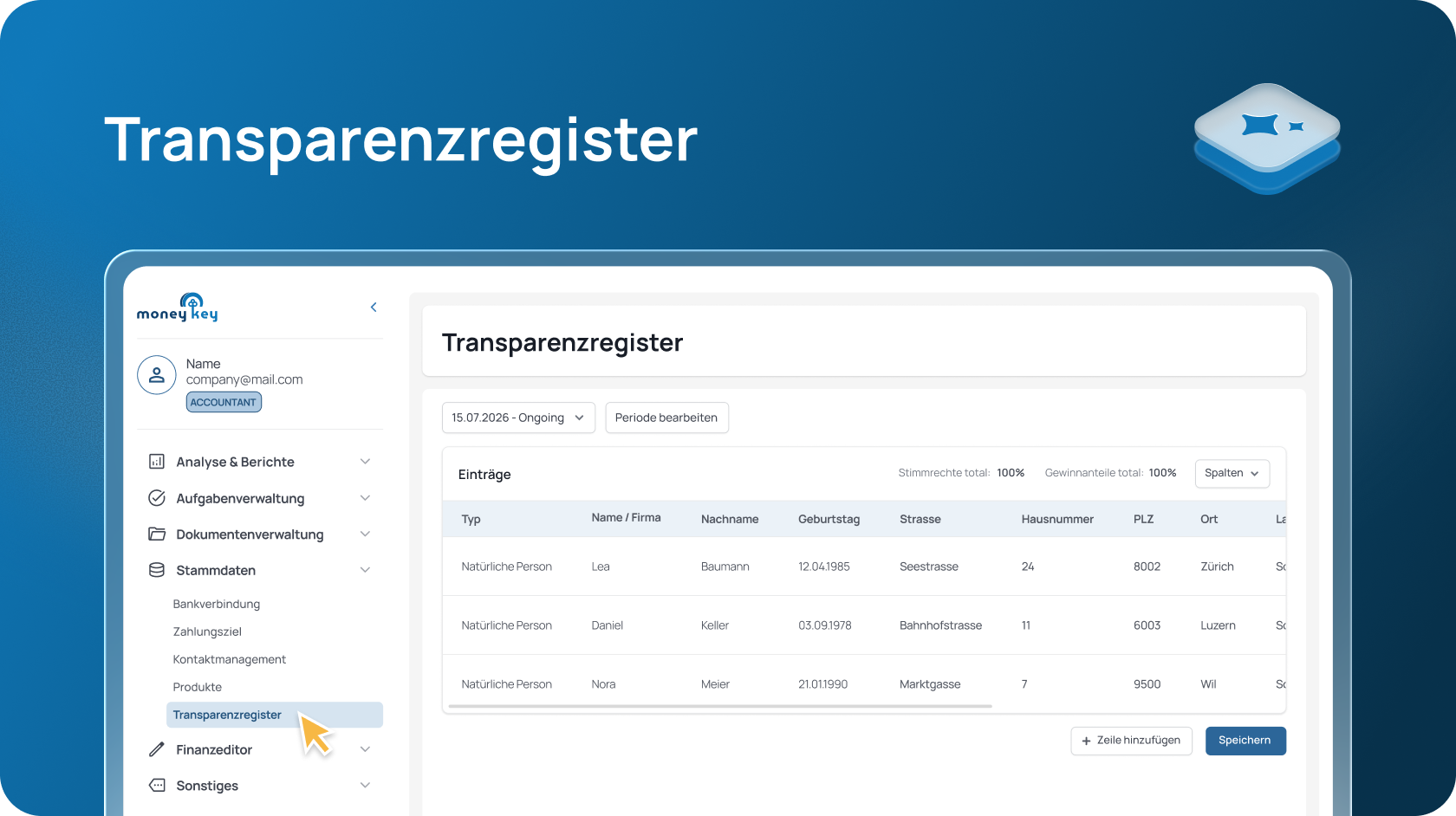
To make the process even easier, Money Key offers a dedicated Transparency Register feature that supports the structured management of the required information.
Together with our experts, this allows us to handle the relevant information for our clients efficiently and keep the process clear and organised.